




Social investment

Social investment is one of many ways that we seek to create social value. We believe we are successful when we work in partnership with communities to achieve long-term social, environmental and economic outcomes.

Our approach and position
Social investment is our voluntary contribution towards initiatives that have the primary purpose of contributing to beneficial outcomes for communities and the environment.
Our social investment strategy aligns with our social value framework and 2030 goals, and strengthens our approach towards partnership and co-creation. Social investment plays an important role in addressing challenges such as community and environmental resilience and requires close collaboration with our partners and stakeholders.
The strategy provides a consistent framework for BHP’s voluntary social investment across the organisation and is guided by four principles: investments are integrated and coherent; enduring; risk-based and social value oriented; and solution-focused and outcome-driven.
Social investment delivery model
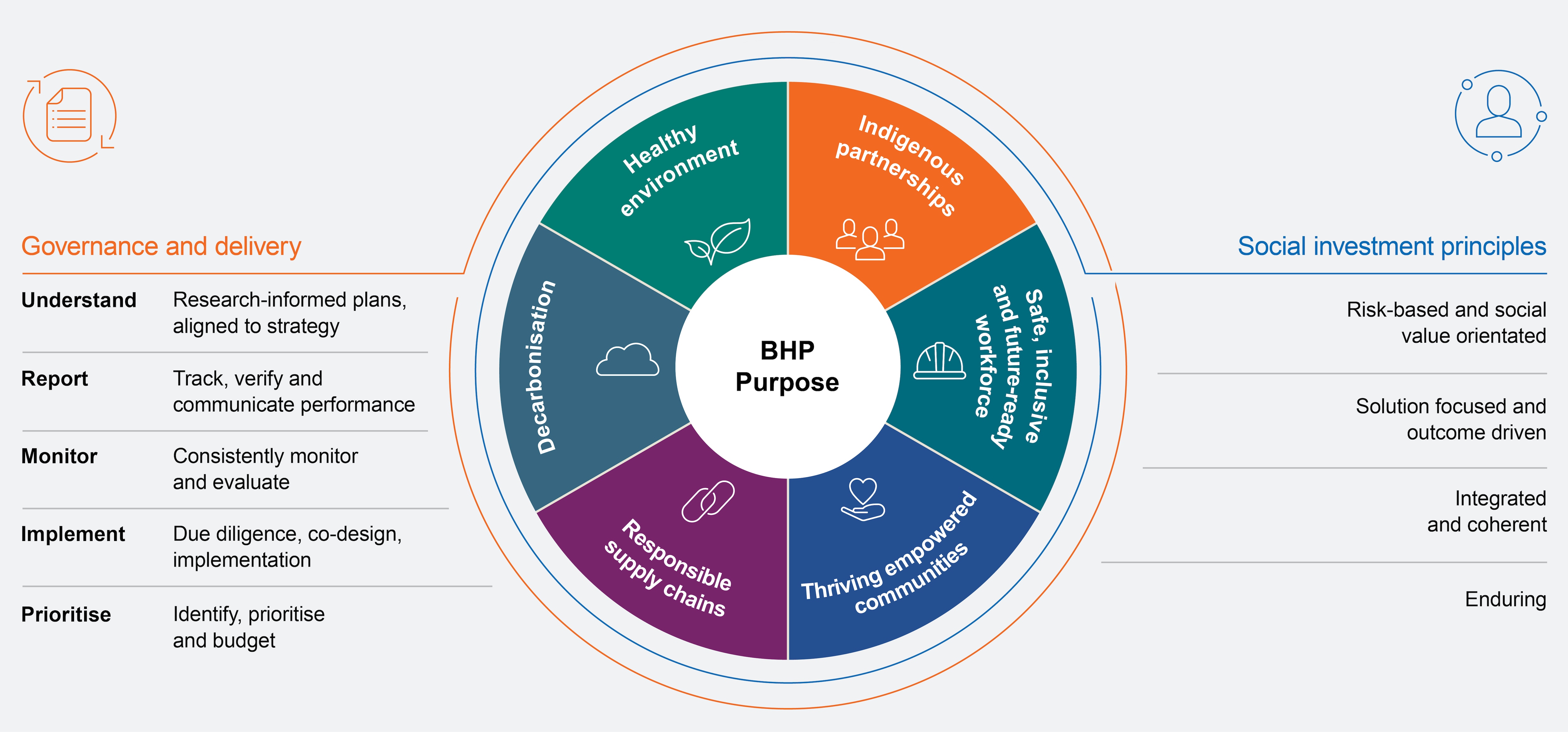
Insights gathered through collaboration with our partners and stakeholders are combined with research, which helps us plan and prioritise our social investment. The four guiding principles outlined above assist our teams to ensure investment opportunities are co-designed and implemented in an equitable manner that respects relevant local customs and contributes to meaningful, lasting change.
For information on the role of the BHP Board in overseeing our approach to and delivery on sustainability refer to the Sustainability approach webpage.
As a global company, we operate across diverse jurisdictions and engage with a wide range of stakeholders, including communities, non-government organisations, government bodies and research institutions. Through regular engagement and ongoing research into environmental, workforce, community and supply chain matters, we seek to understand, manage and respond to stakeholder expectations, priorities and risks.
We engage at local, regional, national and global levels to understand both place-based priorities and broader issues affecting our industry, including challenges that extend beyond national boundaries, such as climate change, human rights and public health. We value two-way dialogue as essential to understanding concerns and perspectives, and stakeholder input is a core element of our approach. For more information on our engagement refer to the Local communities webpage.
We use metrics designed to support evaluation of the outcomes that we seek to achieve through social investment.
Our total social investment is internally monitored and verified each quarter, then externally assured annually and publicly disclosed in our Economic Contribution Report, and as relevant in our Modern Slavery Statement and Australian Indigenous Social Investment Report
We are proud to support the organisations that are important to our employees. Through our Matched Giving Program, BHP matches personal donations made by our employees to eligible not-for-profit organisations at a ratio of 2:1, meaning that for every dollar donated by our employees BHP donates two dollars.
Our Matched Giving Program currently features 100 eligible organisations around the world.
Sustainability case studies, organisational boundary, definitions and disclaimers, and downloads
-
BHP Annual Report 2026pdf

-
Sustainability reporting organisational boundary, definitions and disclaimerspdf
-
Límite organizativo de los informes de sostenibilidad, definiciones y descargos de responsabilidadpdf
-
BHP ESG Standards and Databook 2026xlsx
-
BHP Group Modern Slavery Statement 2026pdf
-
BHP Annual Report 2026, Sustainability Report 7.6 Methodology for calculating Scopes 1, 2 and 3 GHG emissions

-
BHP Climate Transition Action Plan 2024, subject to updates of certain aspects of our assumptions and plans in the BHP Annual Report 2025, Operating and Financial Review 9.8, and BHP Annual Report 2026, Operating and Financial Review 9.10 and Sustainability Reportpdf
-
Global Industry Standard on Tailings Management – Public Disclosure 2026pdf
-
Tailings Storage Facility Policy Statement 2026pdf
-
Case studies