




Sustainability
We are committed to pursuing ways of operating responsibly while supplying products that are essential for the globe to develop, decarbonise and digitalise in order to help transition towards a more sustainable future.
We know our stakeholders and partners are increasingly focused on our sustainability performance and use it as a key determinant in assessing BHP and our industry. We strive to continuously improve and exceed these expectations.
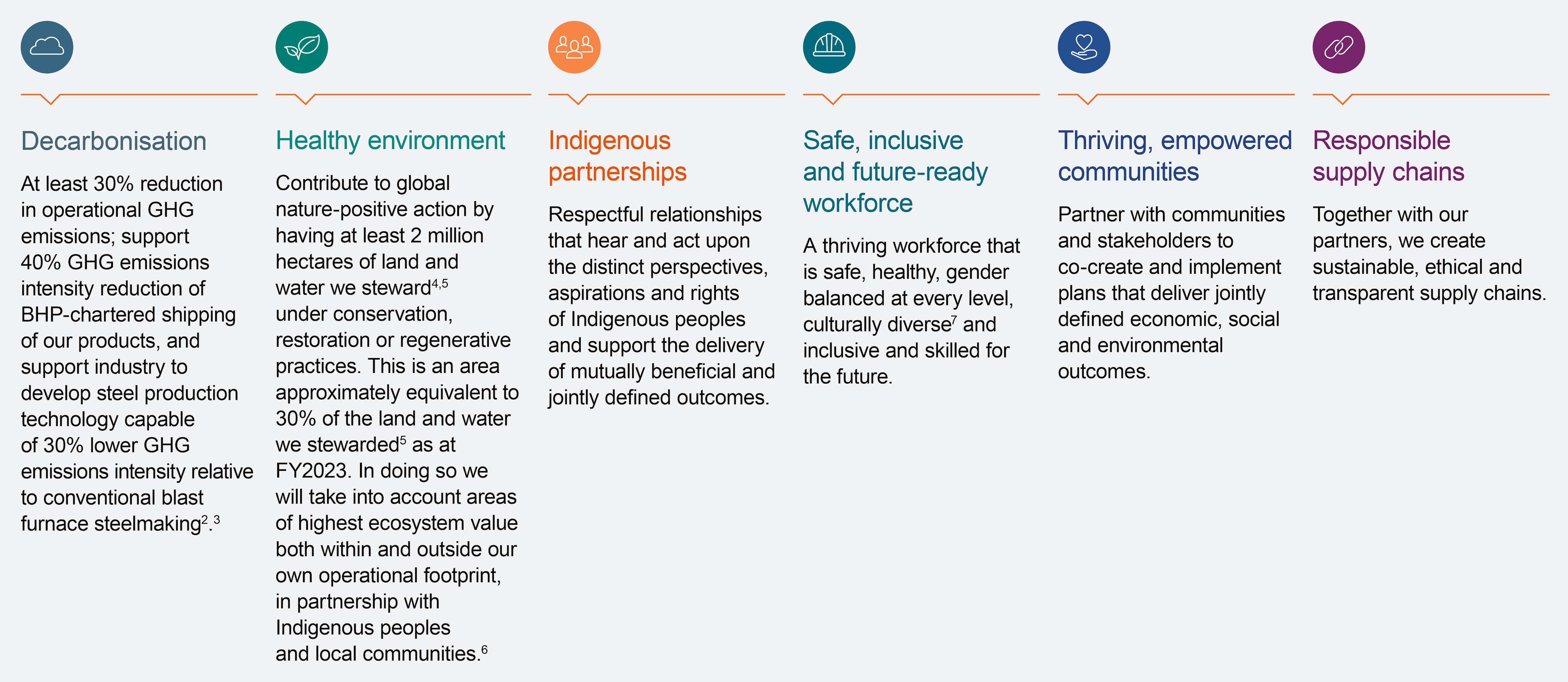
2030 goals1
Our management of sustainability helps generate social value.
Footnotes:
- In setting BHP's 2030 goals, we had regard to existing public sustainability frameworks, including the UN Sustainable Development Goals, the Paris Agreement, the Convention on Biological Diversity, The Global Business Collaboration for Better Workplace Mental Health, and the UN Declaration of the Rights of Indigenous Peoples.
- With widespread adoption expected post 2030.
- For the definition of the terms used to express these positions, including ‘target’, ‘goal’, ‘net zero’, ‘carbon neutral’ and ‘operational GHG emissions’ refer to the BHP Annual Report 2026, Additional information 10.4. For more information on the essential definitions, assumptions, GHG emissions boundaries, measurement approach and adjustments for our targets and goals, refer to the BHP Annual Report 2026, Sustainability Report 5.2 Climate-related targets and 7 Basis of preparation, interpretation and GHG emissions calculation methodology.
- It may include areas we stewarded for a period between FY2023 and FY2030 but have relinquished to a third party with the requisite expertise, and under conditions that create a high likelihood of durability of ongoing conservation, restoration or regenerative management practice.
- Excludes areas held under greenfield exploration licences (or equivalent tenements), which are outside the area of influence of our existing mine operations.
- During FY2026, BHP updated the wording of the Healthy environment goal. For more information on the updates and the reason for them refer to the BHP Annual Report 2026 OFR 9.9.
- Cultural diversity in our workforce will be measured based on our substantive progress towards reflecting the cultural diversity of the societies where we operate.






We also believe sustainability includes playing an appropriate role in addressing global issues, such as climate change, supporting and respecting human rights and advocating for social change, such as by supporting the rights of Indigenous peoples.





The resources lifecycle of exploration and production through to rehabilitation and closure requires us to operate our assets over many decades. This means the long-term health of BHP’s business is directly dependent on the long-term health of society and the environment.


Sustainability case studies, organisational boundary, definitions and disclaimers, and downloads
-
BHP Annual Report 2026pdf

-
Sustainability reporting organisational boundary, definitions and disclaimerspdf
-
Límite organizativo de los informes de sostenibilidad, definiciones y descargos de responsabilidadpdf
-
BHP ESG Standards and Databook 2026xlsx
-
BHP Group Modern Slavery Statement 2026pdf
-
BHP Annual Report 2026, Sustainability Report 7.6 Methodology for calculating Scopes 1, 2 and 3 GHG emissions

-
BHP Climate Transition Action Plan 2024, subject to updates of certain aspects of our assumptions and plans in the BHP Annual Report 2025, Operating and Financial Review 9.8, and BHP Annual Report 2026, Operating and Financial Review 9.10 and Sustainability Reportpdf
-
Global Industry Standard on Tailings Management – Public Disclosure 2026pdf
-
Tailings Storage Facility Policy Statement 2026pdf
-
Case studies

