




Groundwater Modelling Decision Support Initiative
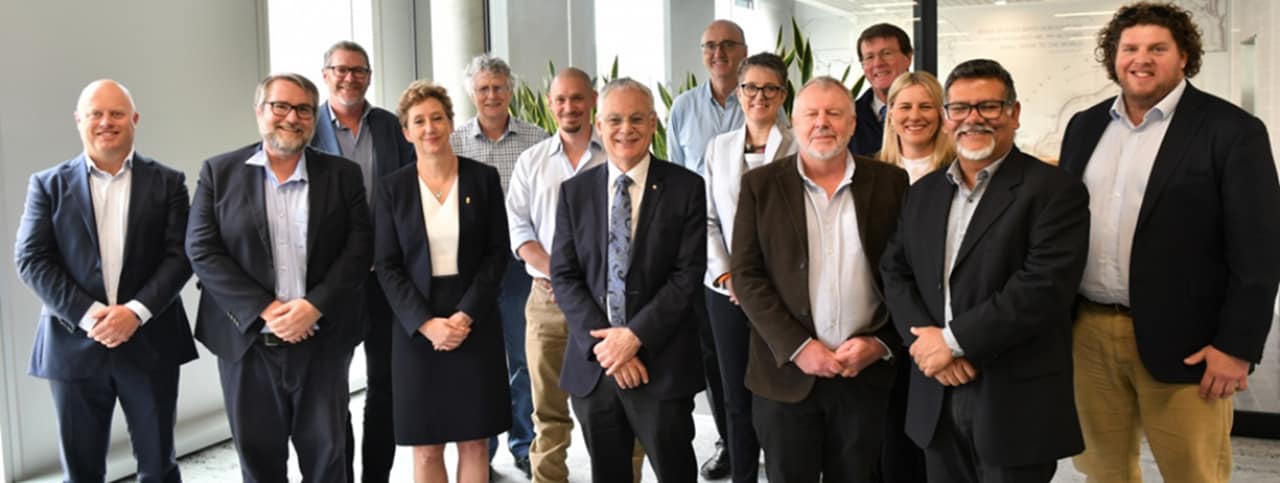
The Groundwater Modelling Decision Support Initiative (GMDSI) is an industry-aligned collaboration established in 2019 to strengthen transparency, technical robustness and shared capability in groundwater modelling globally. The initiative is a critical tool for responsible environmental management and decision-making. Jointly funded by BHP and Rio Tinto and managed by the National Centre for Groundwater Research and Training at Flinders University, GMDSI convenes experts across industry, academia and government to address shared water challenges at catchment scale.
GMDSI’s mission is to promote and improve groundwater modelling as a transparent, defensible and uncertainty aware decision support tool. GMDSI advocates for approaches that explicitly quantify and communicate uncertainty, integrates advanced model partner software with numerical simulators, and rigorously explores plausible system responses. These methods enable clearer insight into catchment-level risks, cumulative impacts and managing groundwater dependent ecosystems, strengthening the basis for sustainable water management decisions.
Education and capability uplift are core pillars of GMDSI. The initiative delivers short courses, webinars, tutorials, one-on-one tutoring, worked examples and open‑access learning resources through its active website and YouTube channel, supporting a broad practitioner community across all experience levels.
GMDSI aims to promote, facilitate and support the improved use of numerical models in groundwater management, regulation and decision-making by:
- promoting increased industry proficiency in decision support modelling and industry-wide discussions leading to improved understanding and communication of technical uncertainty for groundwater management
- providing the means to achieve these aims through promoting and facilitating the use of industry leading model methodologies.
GMDSI objectives are consistent with BHPs water stewardship position statement through collaborative action and learning, and innovating with our stakeholders to improve the confidence and transparency in decisions that relate to potential environmental, cultural diversity and significance.
Activities to achieve the initiative’s goals cover four themes:
Education – Downloadable, online educational videos will be developed on topics that deepen understanding and enable implementation of decision-support modelling. They will be designed to target audiences that span the breadth of modelling skill and experience.
Outreach – GMDSI will host an active website that informs the public of its activities, provides a forum for the discussion of important modelling issues, and makes available issue papers, reports on GMDSI activities, educational videos and news items.
Worked examples – Models will be built in collaboration with government and industry bodies and used to support decisions. This will demonstrate the use of data assimilation and uncertainty analysis methodologies and software, and in doing so, will implement decision-support modelling strategies that assess and reduce management risks.
Research – The initiative supports PhD students with research goals aligned with industry-relevant topics. Two PhDs have been delivered through the initiative.
As one practitioner explained: "Using GMDSI's decision support modelling tools has helped me evaluate and communicate uncertainty in a more structured way when supporting groundwater management decisions."
In 2025, GMDSI continued to deepen industry capability and global collaboration. The second edition of Calibration and Uncertainty Analysis for Complex Environmental Models was released as a freely available resource, providing both the theoretical foundations and practical guidance for simulation-based information extraction, uncertainty analysis and model integrity ‒ intending to provide insights to both modellers and decision-makers. GMDSI also expanded its global practitioner network through a series of groundwater modelling workshops held across Chile, Sweden, Australia and New Zealand. These workshops showcased real-world applications of predictive uncertainty analysis, model design and communication of results to decision-makers, fostering open dialogue and practical learning aligned to evolving water stewardship expectations.
Related Content


