




Steelmaking decarbonisation: progress to near zero


Summary
- The steelmaking industry continues to make positive progress, advancing commercial and demonstration-scale decarbonisation projects, R&D and standards development.
- Regional policy, infrastructure, energy and raw-material availability are driving a diversified approach: technologies to reduce emissions from existing steelmaking assets today and towards deeper abatement longer term, while developing alternative pathways with the strongest potential to enable near zero emissions steelmaking over time.
- BHP is supporting development of multiple pathways, and investing in innovative technologies, to enable near zero emissions steelmaking in the future. In partnership with leading global steelmakers, BHP is executing practical industrial trials to validate the performance of a portfolio of pathways and enabling technologies and support their progression towards future deployment.
Steel is essential to the global economy and energy transition, but it’s also one of the hardest sectors to decarbonise. Here, we examine how industry has progressed over the past year, the forces shaping investment, and why multiple technology pathways will be needed to enable near zero emissions steelmaking.
Investment in steel decarbonisation continues through technology development and policy support across regions
Over the past year, the steel industry continued to make positive progress, advancing commercial and demonstration-scale decarbonisation projects, research and development (R&D), and industry standards.
Recent data indicates investment is continuing, despite a softening in funding commitments. Reported investment and funding commitments totalled US$24 billion for the 12 months to April 2026.1 High capital costs, inability to access competitively priced energy and hydrogen, and limited demand for lower-emissions steel have put additional pressure on project economics. Despite these headwinds, many of the top steelmakers remain committed to their public long-term net zero goals, targets and/or ambitions. While the number of commercial projects has slowed, the industry is continuing to develop the technologies and pathways to enable decarbonisation in the future.
Policy developments in major steelmaking regions are increasingly focused on both supporting investment in lower-emissions technologies and creating demand signals for lower-emissions steel. Together, these measures are helping steelmakers develop lower emissions pathways for existing assets and progressing alternative process routes to enable near zero emissions steelmaking.
China: The expansion of China's national emissions trading scheme to include steel and the transition to a dual carbon control framework, which initially prioritises emissions intensity reduction ahead of total emissions reduction, are strengthening the policy framework for decarbonisation. China Baowu is continuing to progress its commercialised HyCROF blast furnace technology, alongside hydrogen-based direct-reduced iron (DRI) and electric steelmaking technologies through its Zhanjiang low-carbon metallurgy program2. HBIS Group is advancing carbon capture, utilisation and storage (CCUS) technology initiatives and in September 2026, Shougang Group announced successful commissioning of an industrial-scale carbon capture trial facility for blast furnace gas to progress from earlier smaller pilot scale testing.3
India: As India’s steel demand and blast furnace capacity grows, the emissions performance of both existing and new assets will become increasingly important. The introduction of India's Green Steel Roadmap and longer-term inclusion of steel in the Carbon Credit Trading Scheme, together with the development of a national CCUS roadmap, are strengthening the policy framework for decarbonisation.4 Policy and industry-level activity suggests a model that is supportive of blast furnace growth and CCUS to reduce emissions. Important signposts of longer-term trends include Tata Steel’s progressing of the modified blast furnace technology, EASyMelt5, and JSW Steel’s progress to utilise renewable hydrogen in DRI production at Vijayanagar steel works.6
Japan and Korea: Policy support continues to strengthen across multiple decarbonisation pathways. In Japan, the GX Steel framework is supporting blast furnace decarbonisation, including CCUS, and stimulating demand for lower-emissions steel. Both Nippon Steel and JFE Steel have announced investments in electric arc furnace (EAF) based steelmaking capacity, which is expected to increase use of domestic steel scrap7,8. Nationally supported initiatives such as Super COURSE50 continue to progress, with Japan’s New Energy and Industrial Technology Development Organisation (NEDO) also reporting Japan’s first successful prototype production of reduced iron using green hydrogen at a JFE Steel pilot plant9. In Korea, POSCO's HyREX hydrogen-based ironmaking technology is a key long-term pathway under development, with BHP iron ore expected to support testing and help build evidence for future lower-emissions steelmaking routes10.
Europe: Europe remains an important policy leader, with the European Union's Carbon Border Adjustment Mechanism strengthening incentives for emissions reduction and improving carbon accounting transparency. At the same time, the evolving design of the EU Emissions Trading Scheme and the progressive phase out of free emissions allowances are becoming increasingly important considerations for steelmakers as they assess the timing and economics of investments. Several incumbent producers have delayed or re-scoped major projects.
Multiple technology pathways will be needed for lower emissions steelmaking
Market developments suggest that no single technology can address the diversity of the global steel industry. Progress will require development of technologies that enable near zero emissions steelmaking from the blast furnace assets operating today and for alternative, lower-emissions steelmaking pathways with the aim of giving steelmakers commercially feasible options suited to their assets, markets and regional conditions
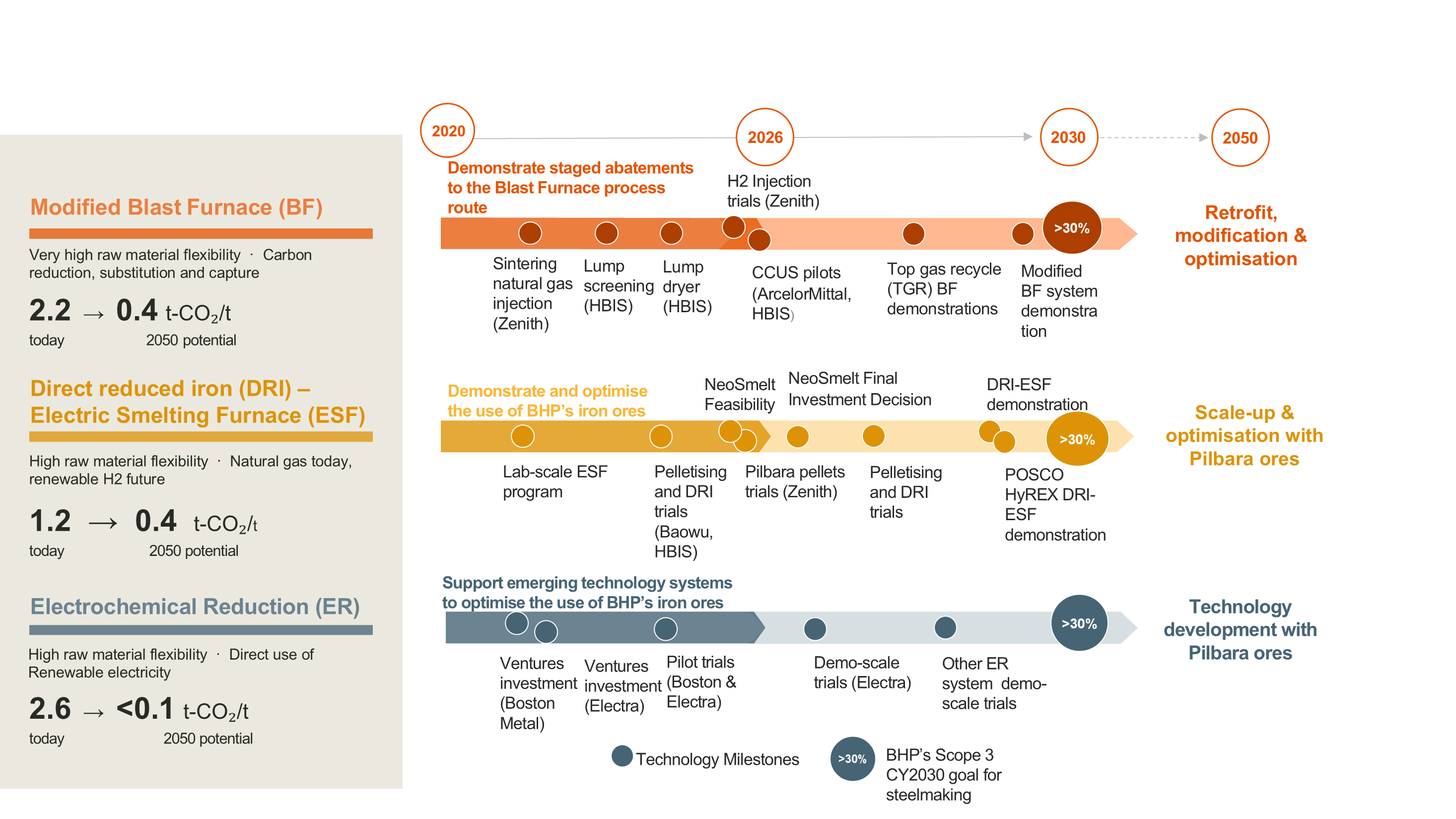
- Modified Blast Furnace (BF) pathway: Blast furnaces are long-life assets that will remain central to global steel production for decades, particularly given Asia’s relatively young fleet. While efficiency improvements and incremental process optimisation could reduce emissions intensity by up to 20% CO2, deeper reductions of approximately 80% require a step change through the implementation of top gas recycling and carbon capture.
- Direct Reduced Iron–Electric Smelting Furnace (DRI–ESF) pathway: For this pathway, based on renewable hydrogen and electricity, to successfully proliferate, technology that can accommodate a wide range of ore types needs to be developed at scale. The DRI–ESF offers an estimated 85% CO2 reduction potential compared with conventional blast furnace steelmaking, while providing greater raw-material flexibility than the conventional direct reduced iron–electric arc furnace route.
- Electrochemical Reduction (ER) pathway: While still at an early stage of development, electrochemical reduction has the potential to produce iron without carbon-based reduction, offering up to a 95% reduction in emissions intensity. Its transformative potential makes it an important long-term pathway for continued research, testing and development.
BHP’s steel decarbonisation program progress and achievements
Through collaboration with 13 of the world’s largest steelmakers, which accounted for one quarter of global steel production in CY202511, as well as research and industry partners, leading steelmakers and industry partners, BHP is supporting development of these pathways through practical trials and demonstrations. Recent highlights include:
Modified BF process route:
- Hydrogen (H2) injection with Zenith Steel: As a retrofit solution for existing blast furnaces, hydrogen-rich gas injection can reduce coal-based fuel rates and lower emissions intensity without requiring a fundamental change to the steelmaking process. Estimates indicate a potential impact greater than 5%12, with Zenith achieving 2–3% so far. During FY2027, BHP intends to continue to support Zenith in exploring the potential for greater reductions.
- Carbon capture with ArcelorMittal and HBIS: Pilot campaigns tested capture from blast furnace gas using amine and vacuum pressure swing adsorption (VPSA) technologies. They demonstrated key performance metrics in operating time, CO2 capture rate, both above 90%, and purity. When applied at scale to blast furnace gas, these technologies could enable a 20–30% reduction in CO2 emissions intensity.12 BHP is looking at supporting partners with further tests on other point sources to benchmark performance and demonstrate higher abatement potential.
- CCUS hub study: The first consortium study phase, completed in April 2026, identified five potential CCUS hub locations across India, Indonesia, Malaysia and Australia. The study highlighted that storage availability, shipping requirements, regulatory alignment and project economics will be critical factors in determining the viability of large-scale CCUS deployment. It also reinforced the importance of collaboration between industry and government to support investment and project bankability.
Recent program highlights: DRI–ESF process route:
- Pellet trials with Zenith: During December 2025, BHP and Zenith Steel completed commercial-scale pellet trials at the Nantong site in China, producing DRI-quality pellets containing 55% BHP Pilbara iron ore and exceeding the project’s 50% target. In the coming months, partners in China will continue working with BHP to further demonstrate the potential to use Pilbara iron ores in this pathway.
- ESF collaboration: This collaboration combines laboratory testing at the University of Newcastle in Australia and partner institutes in Germany with pilot-scale batch testing at Baowu Steel in China. The work is generating insights into the use of BHP Pilbara iron ore in ESF production. Since 2022, through more than 100 trials culminating in more than two tonnes of hot metal production, the program has achieved key technical milestones. These include hot metal quality control, hot metal carburisation targets and slag quality suitable for reuse in cement production.
- NeoSmelt demonstration: The design phase is complete for NeoSmelt, a planned demonstration-scale shaft DRI–ESF pilot plant in Kwinana, Perth. The project brings together joint venture partners AMB Holdings, BHP, BlueScope, Mitsui Iron Ore Development, Rio Tinto and Woodside, combining complementary expertise across resources, steelmaking and energy to demonstrate the value of cross-industry collaboration. The pilot is expected to be commissioned in CY2029, subject to a final investment decision.
- POSCO HyREX demonstration: In September 2026, BHP expanded its partnership with POSCO to advance HyREX, POSCO’s innovative hydrogen-based technology within the DRI–ESF pathway. HyREX can directly process fine iron ore, offering a complementary route to near zero emissions steelmaking from Pilbara ores alongside the pellet-based shaft DRI–ESF route. With BHP’s support, POSCO plans to complete research and development and pilot-scale trials. Demonstration plant trials of BHP iron ores are planned for CY2028 at POSCO’s 300 kt HyREX plant in Pohang.
Recent program highlights: ER process route
ER program: BHP continued working with BHP Ventures portfolio companies Boston Metal and Electra to test Pilbara ores in their pilot plants. Electra reported a 1,400-hour continuous pilot run that included BHP’s Pilbara iron ore fines and began construction of a larger demonstration plant, which is planned to be operational later in CY2026.
Figure 1: Potential ore-based integrated steelmaking pathways13, with BHP’s Steel Decarbonisation program strategy and technology milestones contributing to BHP’s Scope 3 CY2030 goal for steelmaking.
Progressing through collaboration and partnership
Steel decarbonisation remains a long-term industry priority. However, the pace of progress is becoming more measured as economics, infrastructure and policy increasingly shape which pathways can be delivered, where and when. This reinforces the importance of technology readiness, enabling systems and sustained collaboration across the value chain and the need for multiple pathways that reflect regional conditions.
BHP’s steel decarbonisation program to support development of multiple pathways remains aligned with this market context and we are making encouraging progress, working in collaboration and partnership to support the industry in reducing emissions from today’s steelmaking routes while developing the future technologies for near zero emissions steel.
Footnotes
1 As reported by Bloomberg New Energy Finance (BNEF).
2 Source: State-owned Assets Supervision and Administration Commission of the State Council (SASAC).
3 Source: Shougang Group and Rio Tinto commission an industrial-scale carbon capture trial facility for blast furnace gas.
4 Source: Ministry of Steel, Government of India 2026, Green Steel Initiative.
5Proprietary modified BF technology that reforms CO2 and other steel plant gases into a syngas for injection back into the BF through plasma heating.
6 Source: JSW Energy commissions its first green hydrogen plant.
7 Source: Nippon Steel strategy document.
8 Source: JFE Steel to introduce advanced, high-efficiency, large-scale electric arc furnace in Japan, JFE Steel Corporation.
9 Source: New Energy and Industrial Technology Development Organization (NEDO) 2025, Japan’s first successful prototype of reduced iron using green hydrogen.
10Source: BHP and POSCO partner to advance hydrogen-based ironmaking technology.
11 Based on CY2025 data sourced from the World Steel Association.
12 Based on site-specific conditions and the type and CO2 intensity of any supplementary or backfill energy options.
13 Raw materials flexibility indicates whether the process route can use variable iron ore and scrap grades or is sensitive to ore and scrap quality, as is the electric arc furnace, for example. We expect technologies with wider raw material flexibility to be more attractive options for steelmakers. The blast furnace process route GHG emissions intensity ‘today’ value has been calculated using a baseline reference of 2.2 tonnes of CO2-e per tonne of crude steel, as sourced from the IEA Iron and Steel Technology Roadmap (October 2020). The ‘end state’ value assumes a blast furnace basic oxygen furnace steel plant with electrolytic hydrogen injection, top gas recycling and carbon capture, utilisation and storage (CCUS) applied to key point sources, including coke ovens underfiring, blast furnace hot stoves and the on-site power plant, utilising raw materials. The electric arc furnace route GHG emissions intensity ‘today’ value is sourced from an average of a sample of natural gas-based direct reduced iron electric arc furnace sites utilising up to 25% scrap, as well as the CRU Steel Cost Model and BHP analysis. All other GHG emissions intensity values are sourced from BHP analysis.
Related Content


